
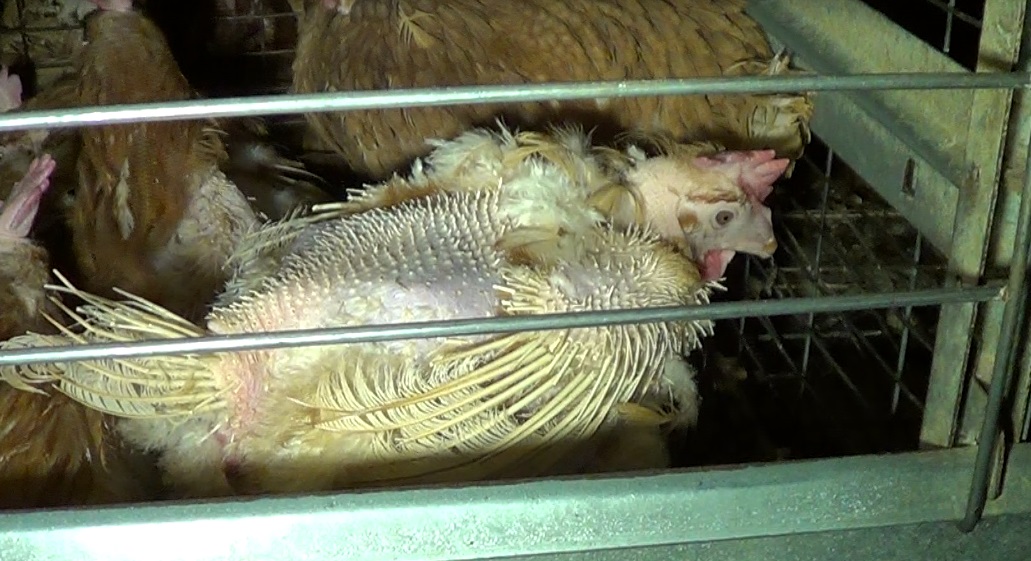
One of our girls, just before rescue. She had a happy ending.
What the egg labels don’t tell you
When we post photos of our rescued battery hens, the comment we see over and over again is “this is why I only buy free range”. It is a kind instinct, and we are grateful for it. But it is based on a story the industry has worked very hard to sell, and most of it is not true.
Every kind of egg farming runs on the same few cruelties. They are easy to hide behind pretty cartons and pictures of hens on green grass, so most people never see them. This page is where we put them in plain view.
Where do the boys go?
Half of all chicks hatched for eggs are male. They cannot lay, and they are the wrong breed for meat, so to the industry they are worthless on the day they are born. Hatcheries breed them by the millions anyway, because they have to, in order to get the females.
Once they hatch, the chicks are tipped onto a conveyor belt and workers sort them by sex the way you might sort plastic parts. The males are then either ground up alive in an industrial macerator, or dropped into bags and left to suffocate. This happens in Australia. It happens everywhere hens lay eggs for us to eat. No label changes what happens on day one, whether that label says “free range”, “organic”, “RSPCA approved” or “backyard”.
Most commercial farms then debeak the surviving females with a hot blade or an infrared beam when they are a day or two old. It is painful enough that some chicks die from stress. This includes most barn and free range farms, not just cages.
A short film we made explaining why we don’t buy free range eggs.
What “free range” really means
In Australia, a farm can legally call itself “free range” with up to 10,000 hens per hectare. That is one hen per square metre. Most commercial free range operations still house 20,000 or more hens together inside giant barns, with a small pop-hole door leading to an outside run that the majority of hens will never walk through. Without enough shelter the girls do not feel safe from predators, so they stay inside, and the farm stays legally “free range”.
We have rescued hens from these sheds. Many of them had never seen the sky. Many were so crowded they had to climb over each other to move. Some came out featherless and raw-skinned, others came out still fluffy, all of them came out of something they should never have been in. The picture on the carton is not a lie exactly. It is just a tiny, staged corner of something enormous and quite bleak.
“But I just want a few backyard hens”
This is something we hear almost as often as the free range line, and it is the part of the story that is hardest for people to hear, because the idea of keeping a few hens in the back garden feels like the kind choice.
The girls you bring home from a produce store or a pet shop almost always come straight from a commercial hatchery. The girls you buy from a small breeder may have been hatched on the breeder’s own property, but the mother and father hens who produced them almost always came from a commercial hatchery themselves. Either way, the line runs back to a parent farm, a facility most people never get to see, which exists only to produce fertile eggs for the rest of the industry. Inside a parent farm there are hens and roosters kept together. The eggs they lay are taken away to hatch, and the male chicks from those hatches are killed on day one like any other laying-breed male. The parent birds themselves are worked for a set period and then slaughtered when their productivity drops. Every laying hen in Australia, even the one pecking around your lawn, traces back to one of these places.
We have been inside parent farms ourselves. Here is what we found.
Meet the Parents
Read the investigation →If you already share your life with rescued or rehomed hens, you are not doing anything wrong by caring for them. What we are asking is that nobody new be bred into this. There are hundreds of ex-commercial hens in Australia right now who need a backyard to land in, and they are the ones we hope people will fall in love with.
A body built to break
Long before she ever sees a shed or a backyard, the hen laying your eggs has already been shaped by us. Modern layer hens have been bred to lay around three hundred eggs a year. Her jungle fowl ancestor laid about ten or twelve. Every one of those eggs takes calcium out of her bones and protein out of her body. Her reproductive system has been manipulated to run at a speed it was never meant to run at, and at a volume it was never meant to produce. It is, quite honestly, a kind of Handmaid’s Tale biology, and it does not end at the shed door.
The hens we rescue, and the hens people keep at the bottom of the garden, all carry the same bred-in problem. As she gets older she becomes vulnerable to reproductive disease, including egg-yolk peritonitis, salpingitis, prolapses, internal laying, and cancers of the oviduct. She needs a vet who knows chickens, and she needs her people to notice quickly when something is wrong. Far too many backyard hens never get that. Some are loved while they lay and then given up on when they get sick or when the eggs slow down, because underneath the affection they are still being thought of as useful. Others were never loved at all. They are tipped into council bins, dropped at shelters, advertised for free on Gumtree, abandoned in the bush or on the side of the road, or left to suffer at the back of a garden with tumours and reproductive cancers nobody is looking for. We have seen all of it. The box by the road that said “free hens” is one of those stories, and it is not an unusual one.
This is part of why we ask people not to bring home any more of them. Not because hens should not be loved, but because every hen born into this body deserves someone who will still be there when her laying stops and her vet bills start.
What happens when she stops laying on a farm
Even on the rare true free range farm, even on a small ethical-looking place with a hand-painted sign out the front, the hens almost all end up in the same place. At around eighteen months, when their egg production starts to dip, they are no longer profitable. That is when they are sent to slaughter.
In the days beforehand, farmers usually withhold feed, because feeding a hen who is about to die is money they will not get back. On catching day, workers grab the girls by their legs or wings and throw them into crates. The hens are calcium-depleted from so much laying, and their bones snap easily. They vomit with terror as they hang upside down. Anyone who has stood outside a shed during a clear-out will tell you that you can hear them screaming from the road.
At the slaughterhouse they are shackled upside down to a moving line that carries them through an electric stun bath. If a hen lifts her head she misses the stunner and reaches the blades fully conscious. If she wriggles away from the blades there is a “back-up killer” behind, but on a fast line they miss too. Hens are scalded alive. Not in theory. In routine, inside Australian abattoirs.
This is the part nobody puts on the carton.
Why we feed their eggs back to them
People sometimes ask why we don’t eat the eggs our rescued hens lay. Part of the answer is that we are vegan and we simply don’t want to. The bigger part is that these girls have been bred to lay an unnatural number of eggs, and every one of those eggs takes calcium and protein out of her body. Cracking an egg onto the ground for her, so she can eat it back, is one of the simplest things we can do to help her rebuild. Once the shell is cracked she knows there is no chick inside and she tucks straight in. It is a small, ordinary kindness, and it is the only egg we will ever encourage anyone to “eat”.
The kind way out
The truth is there is no such thing as a humane egg. Every label funds the same hatchery, the same parent farm, the same slaughter line, and the same bred-to-break body. The very good news is that you do not need eggs. Not for baking, not for breakfast, not for anything. Aquafaba whips like egg whites. A mashed banana or a flax egg binds a cake. Silken tofu makes a better quiche than I ever remember eggs making. Your supermarket is full of plant milks, vegan cheeses and mock meats that did not exist ten years ago.
If you want a hand getting started, Vegan Easy is the friendliest place we know, with free recipes, a 30-day challenge if you want one, and no lectures. And if you want to see the full picture of what we are talking about on this page, the Australian documentary Dominion is free to watch online. It is hard, and it is honest, and once you have seen it the egg carton looks very different.
Thank you for reading this far. Every person who stops funding egg farming, even imperfectly, even slowly, makes the world a little kinder for the girls we have not rescued yet.