
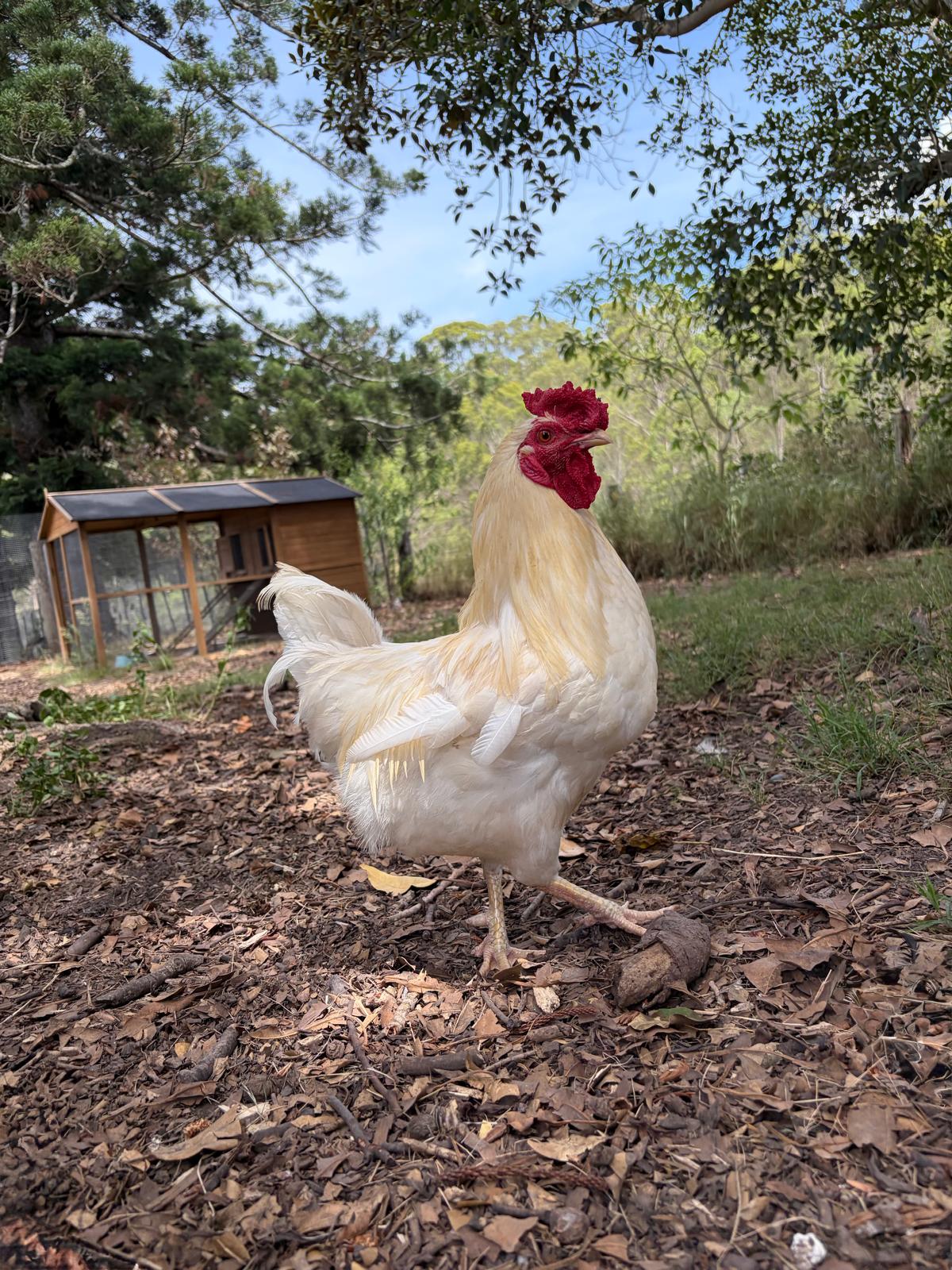
This is Randy, safe now at our Hen Haven. He and his seven brothers were dumped in the bush with their wings clipped short so they could not fly or defend themselves.
Please don’t run a hatching project.
We hear from people almost every day, by phone, email and social media, desperate for help rehoming unwanted animals from classroom hatching projects. Most of them are roosters. Some of them are sick. Some of them have already been dumped. All of them were brought into the world for a lesson, and now have nowhere to go.
A hatching project involves keeping fertilised eggs in an incubator so that children or residents can watch the chicks or ducklings hatch. It is run in schools, early learning centres, libraries, retirement homes and disability services. It is almost always described as educational. It is almost never described by the thing it actually is, which is the start of a life that nobody has planned for.
This page is for parents, teachers, carers and decision-makers who are thinking about whether to run one, and for anyone who has already been handed a chick and doesn’t know what to do next. If you only take one thing from it, please let it be this: there are much kinder ways to teach children about the life cycle, and we would love to help you find one.
Take this with you
We have put together two short resources you are welcome to download, print, share, or send to your school. Please use them however you like.
- Hatching Projects Information Sheet(PDF, 2 pages)
- Letter to my child’s school – Template(PDF, 2 pages)
- Letter to my child’s school – Editable Word version(.docx)
1. Hatching projects fund factory farming
The fertilised eggs used in hatching projects come from commercial hatcheries, which are supplied by parent farms. The mother and father birds on those farms are kept in intensive conditions, never see their babies, and are slaughtered when their productivity drops. Every hatching project kit bought is another small order placed with that system.
A mother hen would naturally begin softly clucking to her unhatched chicks days before they break through the shell. She would turn them gently under her body. She would be a devoted and attentive mother from the moment they arrived. In a hatching project she is somewhere else entirely, inside a shed. The children never meet her, and nobody tells them she exists. Which means the one thing a hatching project claims to teach, the life cycle of a chicken, is the one thing it is not actually showing.
2. A classroom is not a safe place for a newborn chick
Chicks are fragile. They need constant temperature, clean bedding, immediate access to food and water, and a vet who knows poultry if anything goes wrong. Classrooms and early learning centres cannot provide round-the-clock care, particularly at weekends and during school holidays. Even the kindest children can handle a chick too roughly, and sick chicks often do not get the help they need in time.
We have lost count of the number of calls we have taken from teachers describing a chick who has stopped eating, or a chick whose leg has gone sideways, or a chick who is struggling to breathe. By the time we hear about it, there is usually very little we can do.
3. They teach children the wrong lesson about animals
Watching a chick hatch inside a machine teaches children that animals are disposable. That they can be bred for a lesson and then moved on. Children arrive in the world with enormous natural compassion for animals. A hatching project does not nurture that compassion, it asks them to set it aside, to watch a baby appear and then to let that baby go somewhere unknown a few weeks later. We can do so much better than that. A far more powerful lesson is that animals are individuals with feelings and a lifelong need for care.
4. They create roosters nobody planned for
Roughly half of every hatch is male. Roosters crow, and in most suburban council areas they are not allowed to be kept. When the project ends, the chicks are either given back to the hatching company (where they are killed), pushed onto parents who feel they cannot say no, or dumped. Some are taken to the vet or the RSPCA to be killed. Others are left in cardboard boxes on the side of the road, or in the bush, where they starve or are taken by predators.
And the children who hatched those chicks, and named them, and loved them, are often heartbroken when the time comes for them to leave. They were promised a wonder. Nobody warned them about this part of it.
If you would like to read more about what actually happens to these roosters, and the comforting story everyone tells themselves instead, we wrote about it here: “They’ll Be Fine: The Lie That Costs Roosters Their Lives”.
5. They overwhelm sanctuaries that are already full
Every rescue and sanctuary in the country is already working beyond capacity, and roosters are the hardest of all to place. When a hatching project ends and a panicked parent starts ringing around, the calls come to us. We rarely have space. We have to say no, and the birds who needed somewhere to land do not always find it. All of this suffering comes from an activity that was presented as an educational experience.
Better alternatives
There are many ways to teach children about the chicken life cycle without creating lives that nobody has a home for. Here are a few we recommend.
Use a model egg kit.
Modern Teaching Aids sells a Chicken Life Cycle Set of 21 Eggs that opens to show day-by-day embryo development, with no incubator and no living animal required. It is reusable, affordable, and it teaches the science just as well.
Grow a plant project instead.
A seed-growing project teaches the life cycle just as beautifully, with real practical food-growing skills attached. Children learn how a living thing begins, what it needs to thrive, and where food actually comes from, without creating a baby animal who will need somewhere to go at the end of term.
Visit a farm sanctuary.
Many sanctuaries offer educational visits where children can meet rescued hens, roosters and ducks as individuals. The lesson this leaves behind is infinitely more powerful than a machine.
Watch hatching on screen.
A short search for “chick hatching” returns many beautifully filmed videos. Children see exactly what they would see in the classroom, without creating a baby bird who needs a home next month.
Go bird watching.
Wild birds are the best teachers of the life cycle. A pair of binoculars and a walk in the local bush shows children that birds have their own lives, nests and families already, and that our job is to leave them to it.
If your school is planning a hatching project, here’s what you can do
The most powerful thing a parent can do right now is write to their principal. Schools listen to parents. They often don’t know any of this, and they are rarely being malicious, they are usually trying to bring a bit of wonder into a classroom.
We have written a letter you can use. It is a polite, calm letter to your principal setting out the main reasons hatching projects cause harm, and it links to the information sheet so the school can read more if they want to. You are welcome to download it, adapt it, or copy it straight into an email.
Download the letter (PDF) · Download the editable Word version
If your project has already begun
Please make sure it is the last one, and focus on finding every chick a safe, lifelong home. Do not send the birds back to the hatching project company, as they are almost always killed regardless of what the company claims. Anyone taking a chick home needs to understand that roughly half of all chicks hatched are male, that roosters cannot be kept in most suburban areas, and that chickens can live 8 to 12 years with vet bills along the way.
A note from us
We know the teachers and carers who run hatching projects are not trying to be unkind. They are trying to bring wonder into a classroom. We are asking, on behalf of the roosters nobody planned for and the mother hens who will never meet their chicks, for that wonder to be found somewhere else. There are so many better ways.
Thank you for caring enough to read all the way to the end.